
If you run training courses, someone has probably asked you this question already. Is your course accredited? A lot of training providers are not sure how to answer, or where to even start.
This guide covers course accreditation from the ground up. What it actually means, why it matters, what the process looks like, and how to keep it once you have it. By the end, you will know exactly what steps to take next, whether you are training employees, teaching a professional skill, or running an online school.
What Is Course Accreditation?
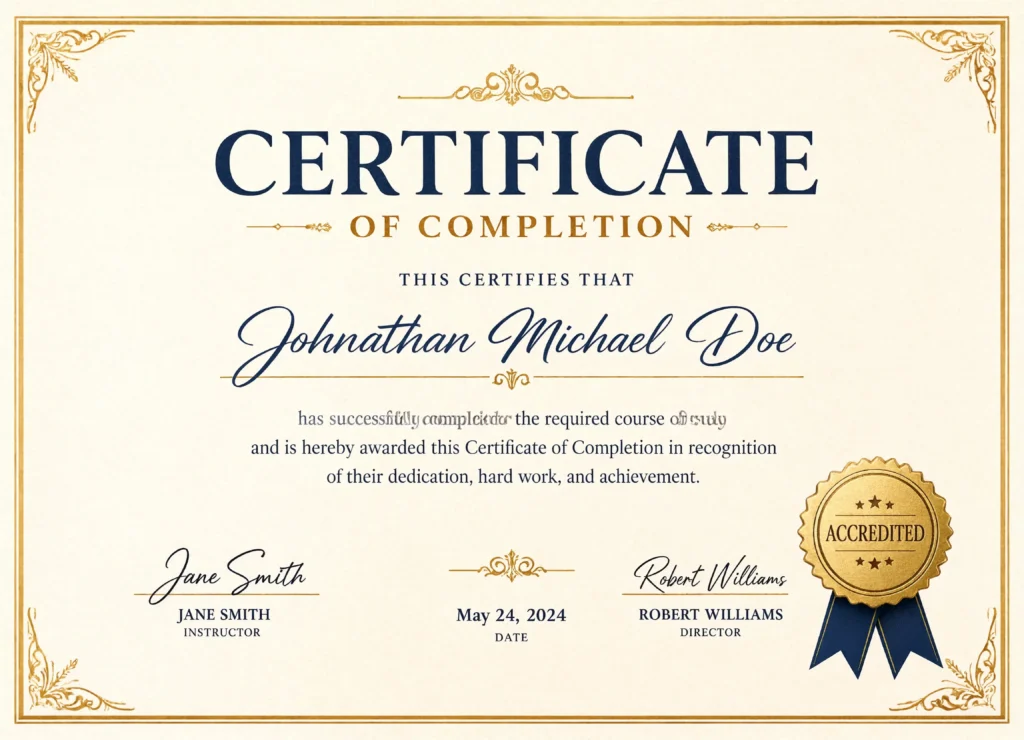
So, what is course accreditation? In simple words, it means an outside group has checked your course and confirmed it meets a clear set of quality standards. That outside group is usually called an accreditation body or an awarding organization.
Accreditation is not something you give yourself. You cannot just print “accredited” on your course page and call it done. A real accrediting body reviews your course content, how you teach it, how you test learners, and how you support them, then decides if your course meets their standard.
This review is not a quick glance either. Depending on the body, it can include reading through your full course materials, checking sample assessments, interviewing your instructors, and sometimes even sitting in on a live session or reviewing recorded ones. The goal is to confirm the course actually delivers what it claims to, not just that the marketing sounds good.
This matters because learners, employers, and regulators all use accreditation as a shortcut for trust. Nobody has time to personally check every course out there. An accredited badge tells them someone independent already did that checking.
Accreditation also is not the same everywhere. A body that accredits nursing courses works very differently from one that accredits business skills training or a coding bootcamp. Standards, paperwork, and review length all shift based on the subject and the country you operate in. That is one reason a single, universal checklist does not exist. What stays the same is the basic idea. Someone outside your organization checks your course against a written standard, and either confirms it passes or tells you what to fix.
Course Accreditation vs Certification
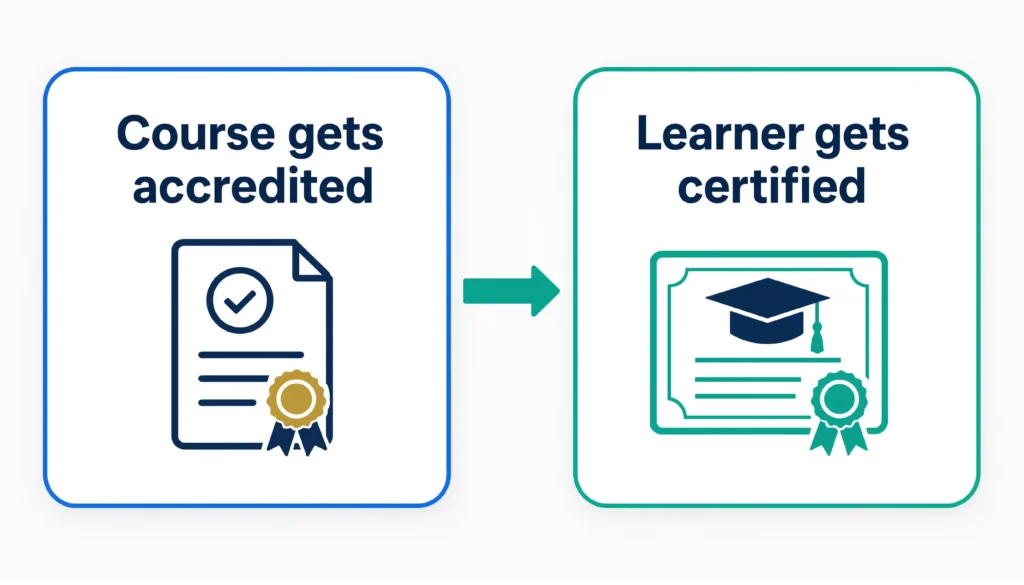
People mix these two words up all the time, and it causes real confusion. Accreditation is about your course or your organization. Certification is usually about an individual learner, showing they passed a specific course or exam.
Think of it this way. Your course gets accredited. A person who finishes your course gets certified. One is a stamp of approval on the training itself. The other is proof that one specific person completed it and met the bar.
This distinction matters for marketing too. Saying your course is accredited and saying your learners become certified are two different claims, and mixing them up in your marketing can cause real problems with regulators in some industries. Our deeper look at course accreditation vs certification breaks down exactly where people get this confused and why it matters for how you market your course.
Why Accreditation Matters: The Benefits of Accredited Courses
Getting accredited takes real effort, so it is fair to ask if it is worth it. For most training providers, the answer is yes, and the course accreditation benefits show up in a few clear ways.
Accredited courses are easier to sell. When a learner is comparing five similar courses, an accreditation badge often becomes the deciding factor, especially for anything tied to a job requirement or a professional license.
Accredited courses often qualify for funding or reimbursement that non accredited training cannot access. Many employers will only reimburse staff for training if it carries a recognized accreditation.
Accreditation also pushes you to improve your own course. The review process usually points out gaps in your content, your assessments, or your support that you might never have noticed on your own. Our full breakdown of the benefits of accredited courses covers this in more detail, including how it affects pricing and enrollment numbers over time.
Can Online Courses Be Accredited?
Yes, and this is one of the most common questions we get. Online course accreditation works basically the same way as accreditation for an in person course. The accrediting body still checks your content, your assessments, and your learner support. They just also check things specific to online delivery, like how you verify who is actually taking the test, and how your platform tracks progress.
Some accrediting bodies specialize in fully online programs. Others accredit both online and in person courses under the same standard, as long as the online version meets the same bar.
A few extra questions come up almost every time with online course accreditation. How do you prove the person taking the final exam is actually the person enrolled. How do you track whether someone actually watched a video or just let it play in the background. How do you handle learner support across different time zones. None of these questions are deal breakers, but a reviewer will expect a real answer to each one, not a guess.
If you are building or converting a course to run online, our guide on whether online courses can be accredited walks through the specific extra requirements you should expect.
Course Accreditation Requirements
Requirements vary by accrediting body and by industry, but most course accreditation requirements fall into a few common buckets.
Clear learning outcomes. You need to state exactly what a learner will be able to do after finishing your course, not just what topics you cover.
Qualified instructors. Most bodies want proof that whoever teaches or built the course actually has the expertise to do so.
A real assessment method. A course that hands out a certificate just for watching videos rarely passes review. You usually need a quiz, project, or exam that actually measures whether someone learned the material.
Documented processes. You need to show how you update content, handle learner complaints, and keep records, not just that your course looks good today.
Financial and organizational stability. Many bodies also want some proof that your organization is stable enough to keep running the course and supporting past learners.
None of these requirements are meant to be a trick. They exist because a course that skips one of them usually fails learners in a predictable way. Skip clear learning outcomes, and learners cannot tell if the course actually taught them anything useful. Skip a real assessment, and a certificate becomes meaningless. Skip documented processes, and there is no way for a reviewer, or you, to catch problems before they pile up.
Our detailed page on course accreditation requirements walks through each of these in more depth, with a checklist you can use before you apply.
“[Placeholder expert quote, for example from our Head of Accreditation Services or a training compliance advisor, on the single biggest requirement gap they see when providers first apply. Replace with a real, attributed quote before publishing.]”
The Course Accreditation Process, Step by Step
The course accreditation process usually follows a similar shape no matter which body you use, even though small details differ. Knowing the shape ahead of time makes the whole thing feel far less mysterious once you actually sit down to apply.
How to Get Your Online Course Accredited
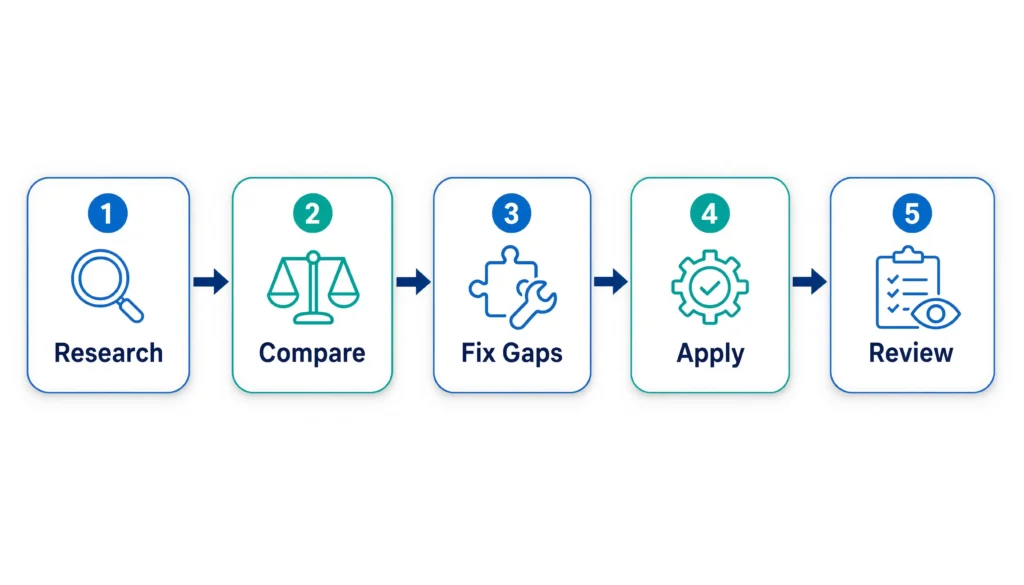
First, you research bodies that accredit courses in your subject area. Look at who your competitors or peers already use, and check whether employers in your field actually recognize that body’s name.
Then you review their specific standards and compare them against your current course, line by line if needed. This step alone often reveals gaps you did not know you had, like missing documentation on how you handle learner complaints or update outdated content.
Next, you fix any obvious gaps before you apply, since a rushed application with known gaps usually gets rejected or delayed. It is almost always faster to fix problems before submitting than to fix them after a reviewer flags them.
Then you submit your application along with the required documents, and wait for review. Reviewers may come back with follow up questions, so build in time for at least one round of clarification before final approval.
Our step by step guide on how to get your online course accredited walks through each of these stages with a realistic timeline for each one.
Choosing the Right Accreditation Body
Not every accrediting body fits every course. Some focus on a specific industry, like healthcare or finance. Others are broad and cover many subjects. Check whether employers and regulators in your specific field actually recognize a given body before you apply, since accreditation from a body nobody in your industry has heard of will not help you much.
Cost and turnaround time vary a lot between bodies too, even within the same industry. A well known body might take longer and cost more, but carry far more weight with employers than a cheaper, faster option most people have never heard of. Weigh recognition against cost and speed, rather than picking whichever body responds first. Bodies like CHEA in the US or Ofqual in the UK publish lists of recognized accreditors, which is a good starting point for checking legitimacy.
Our full guide on choosing the right accreditation body covers the exact questions to ask before you commit to one.
Common Accreditation Mistakes
The most common mistake is applying before your course is actually ready, hoping the reviewers will point out exactly what to fix. This usually backfires and slows the whole process down, since most bodies expect you to arrive with a course that already meets their published standard.
Another common mistake is underestimating how much documentation is required, then scrambling to produce records at the last minute. Things like instructor qualifications, complaint logs, and update history are much easier to gather as you go than to reconstruct months later.
A third common mistake is choosing a body based on price alone, without checking whether anyone in your industry actually recognizes it. Our post on common accreditation mistakes covers the specific errors that cause the most rejections and delays.
Accreditation Timeline and Costs
Timelines vary widely, from a few months for a simple course to over a year for something more complex or heavily regulated. Costs also vary a lot, from a modest application fee to a much larger figure for organizations that require an on site review.
Budget for more than just the application fee. Many providers underestimate the staff time needed to gather documentation, update content to meet requirements, and respond to reviewer questions. That hidden cost often ends up bigger than the application fee itself.
Our detailed page on accreditation timeline and costs breaks down realistic ranges so you can budget properly before you start.
Maintaining Course Accreditation
Getting accredited is not a one time task. Maintaining course accreditation usually means regular reviews, renewed applications every few years, and keeping your documentation up to date the whole time, not just right before a renewal deadline.
Most accrediting bodies also expect you to update your course content as your field changes. A course that was accurate five years ago but never updated since is a common reason accreditation gets pulled during a renewal review.
A simple routine helps here. Set a fixed schedule, like once a year, to review your content for anything outdated, check that your assessments still match your stated learning outcomes, and confirm your documentation is current. Treating this as a regular habit is far less painful than trying to catch up right before a renewal deadline.
Our guide on maintaining course accreditation covers what an ongoing compliance routine actually looks like, so renewal does not turn into a scramble every time.

Accreditation for Training Providers: What Is Different
Accreditation for training providers, as opposed to a single course, usually looks at your whole organization. This can include your staff qualifications, your financial stability, your complaint handling process, and how consistently you deliver quality across every course you offer, not just one.
This broader review exists because a single well built course does not guarantee every course an organization runs meets the same bar. A body accrediting your whole organization wants confidence that quality holds up across your entire catalog, not just the one course you happened to polish for the application.
Training course accreditation at the organization level often takes longer and asks for more documentation than accrediting a single course. But it can also save time later, since once your organization is accredited, adding new courses under that same accreditation is often faster than starting from scratch each time. Many larger providers pursue training course accreditation for this exact reason, even when a single course could technically qualify on its own. Bodies like IACET specialize in accrediting continuing education and training providers at the organizational level, rather than course by course.
For example, a training company that runs twenty different workplace safety courses might find it far more efficient to get the whole organization accredited once, then add each new safety course under that same umbrella, rather than applying separately every single time they launch something new.
Future Trends in Course Accreditation
Accreditation is not standing still. More bodies are building faster, partly digital review processes instead of relying only on lengthy paper applications. Skills based, narrower accreditations are also growing, alongside traditional broad program accreditation, especially for shorter job focused courses.
AI tools are starting to show up in how some bodies check learner identity and monitor exams, though human reviewers still make the final call on whether a course meets the standard.
Micro credentials and stackable certificates are also gaining ground, where a learner earns smaller, accredited pieces that build toward a bigger qualification over time, instead of one long course with a single pass or fail outcome at the end. Providers who can offer this kind of flexible, accredited path may have an edge over ones still stuck with a single rigid course structure.
Our deeper look at future trends in course accreditation covers what providers should watch for over the next few years, so you are not caught off guard by a standard that shifts under you.
How to Get a Course Accredited: A Quick Recap
If you want the short version of how to get a course accredited, here it is. Pick a body that fits your subject and is recognized in your industry. Compare your course against their published standards. Fix the obvious gaps first. Gather your documentation early. Apply, and expect a review process that may ask follow up questions before final approval.
None of this happens overnight, but none of it is mysterious either. Every accrediting body publishes its standards for a reason. Reading them carefully before you apply saves far more time than rushing an application and fixing problems after rejection.
It also helps to talk to someone who has already been through the process with the same body. They can often tell you which parts of the standard reviewers care about most in practice, beyond what the published document says on paper.
Frequently Asked Questions
Q: How long does course accreditation usually take?
A: It varies widely, from a few months for a simple course to well over a year for something complex or heavily regulated. Applying with your documentation already in order speeds this up considerably.
Q: Do I need accreditation to sell a course at all?
A: No, you can sell a course without accreditation. But for anything tied to a professional requirement, a job qualification, or employer reimbursement, accreditation often makes the difference between a course people can actually use for that purpose and one they cannot.
Q: Can a single instructor get their own course accredited, or does it need to be a full organization?
A: This depends on the accrediting body. Some accredit individual courses regardless of organization size. Others expect a certain level of organizational structure before they will even review an application.
Q: What happens if my course fails an accreditation review?
A: Most bodies will tell you specifically what needs to improve, and let you reapply after making changes. A failed first review is common and rarely permanent, as long as you address the specific feedback given.
Q: Is online course accreditation treated differently than in person accreditation?
A: The core standards are usually similar, but online courses face extra scrutiny around identity verification, platform tracking, and how learner support works without a classroom setting.
Q: Does accreditation expire?
A: Yes, almost always. Most bodies require renewal every one to five years, depending on the industry and the body’s own rules. Maintaining accreditation is an ongoing responsibility, not a one time achievement.
Q: Can I get more than one accreditation for the same course?
A: Yes, and some providers do this on purpose, especially if their learners span more than one industry or country where different bodies carry more weight.
Final Thoughts
Course accreditation is not just a badge on a webpage. It is a real signal that an outside group checked your course and found it meets a real standard. That signal helps learners choose your course with more confidence, helps employers justify paying for it, and often opens doors that stay closed to non accredited training.
Whether you are just starting to explore this or getting ready to apply, the steps stay largely the same. Understand the requirements, pick the right body for your field, prepare your documentation honestly, and treat accreditation as an ongoing standard to maintain, not a one time box to check.
Most providers who go through this process once say the same thing afterward. The review itself, even when it points out real problems, usually makes the course better. Treat that feedback as useful information rather than a personal failure, and the whole process becomes a lot less stressful.