
If you have ever earned a badge for finishing a course, or watched a progress bar fill up as you learned, you have already seen gamification at work. So what is gamification in eLearning, exactly? In this guide, we will answer that question in plain words. No jargon, no long tech talk. Just a clear look at what this idea means and why so many courses use it.
This post is part of our bigger guide on eLearning. If you want the full picture of online learning first, you can read our guide on what eLearning is and how it works. Here, we will zoom in on one piece of that world: what is gamification in eLearning and how it changes the way people learn. A lot of people search for what is gamification in eLearning because they keep seeing points, badges, and leaderboards in training apps and want a plain answer. By the end of this post, you should be able to explain what is gamification in eLearning to a coworker in one or two sentences, without any confusion.
What Is Gamification in eLearning, In Simple Words
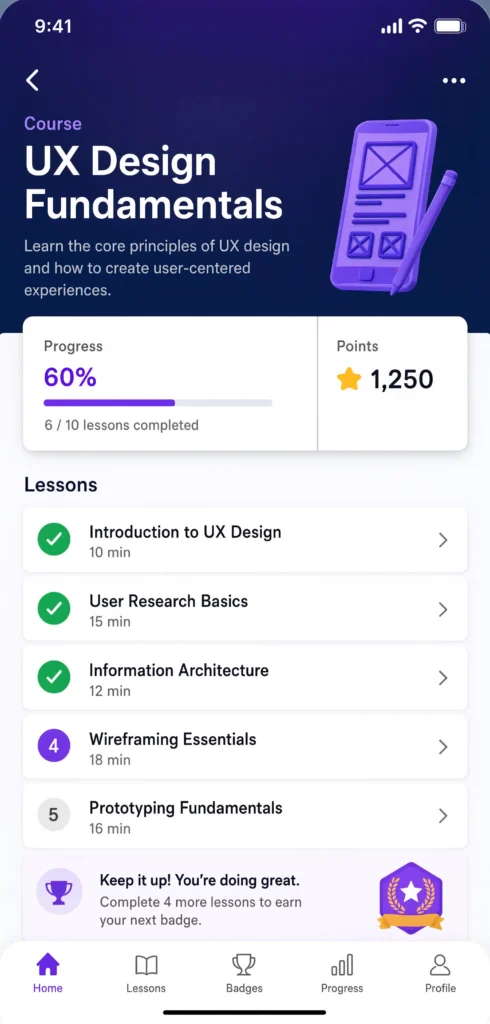
Let’s start with the basic question. What is gamification in eLearning? Gamification in eLearning means adding game parts, like points, badges, levels, or leaderboards, into a course that is not actually a game. The course still teaches real skills. The game parts are just there to make learning feel more fun and to keep learners coming back.
Think about a fitness app that gives you a badge for a seven day streak. The app is not a game. It is still tracking real workouts. The badge is just there to make you want to keep going. That is the same idea behind what is gamification in eLearning. The learning stays real. The game layer sits on top of it.
People often mix up gamification with game-based learning, so it helps to be clear here. Game-based learning means the entire course is a game. Gamification is different. It means you take a normal course and add small game features on top. This difference is one of the first things to understand when you ask what is gamification in eLearning.
Why Gamification in eLearning Actually Works
Now that we have covered what is gamification in eLearning at a basic level, let’s look at why it actually works.
People like to see progress. A plain course often feels like a long, flat road with no clear markers. Adding points or a progress bar gives learners a way to see how far they have come. This alone makes people more likely to finish a course instead of quitting halfway through.
People also like small rewards. A badge or a certificate does not pay real money, but it still feels good to earn. This is one of the main reasons companies ask what is gamification in eLearning good for. The short answer is that it taps into things people already enjoy, like winning, leveling up, and seeing their name on a leaderboard.
Competition can help too, but only in small doses. A little friendly competition between coworkers can push people to finish training faster. Too much competition can stress people out, so most good courses keep it light and optional.
Common Game Parts Used In eLearning
Let’s look at some of the most common game parts used in courses today.
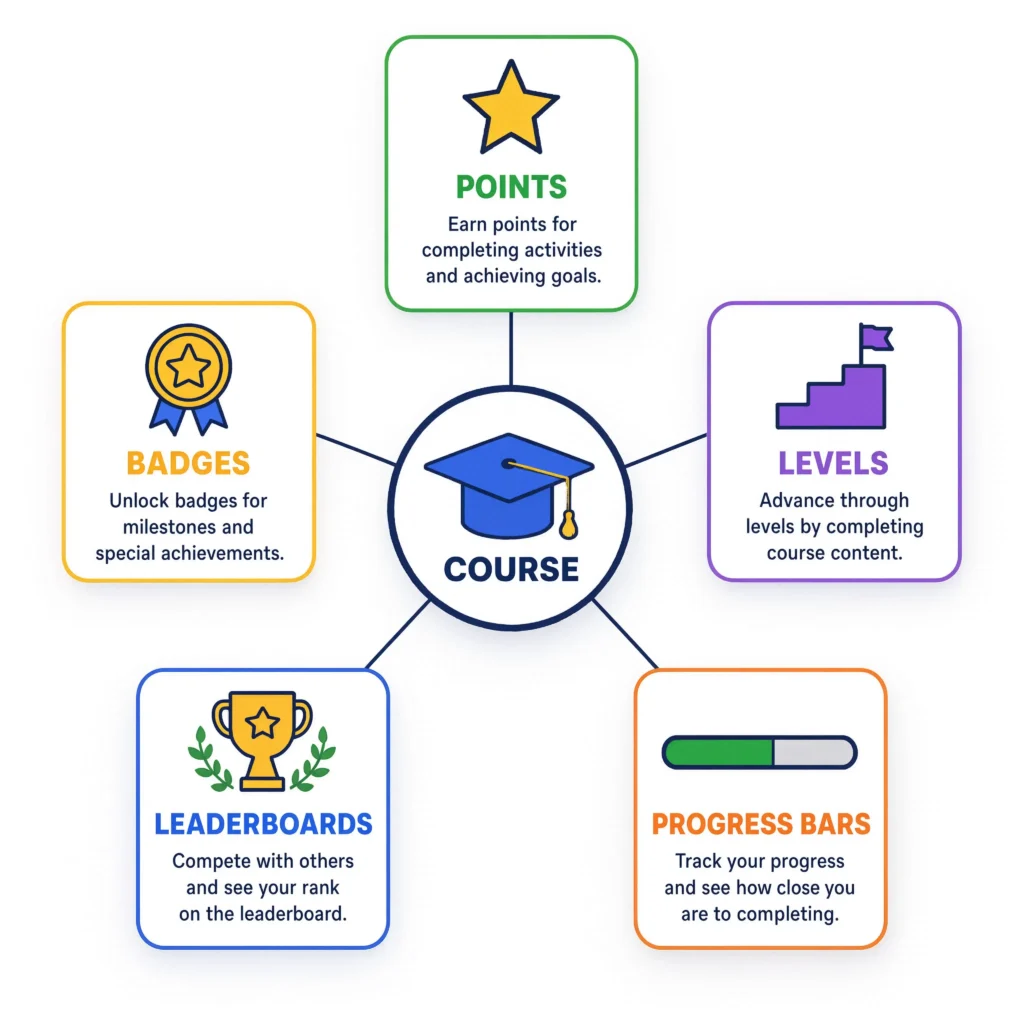
Points. Learners earn points for finishing lessons, passing quizzes, or helping other learners.
Badges. A badge shows that a learner hit a certain goal, like finishing a module or passing with a high score.
Levels. Learners move up levels as they gain more points, similar to leveling up in a video game.
Leaderboards. A leaderboard shows top learners in a group, which can add friendly competition.
Progress bars. A simple bar that fills up as a learner moves through a course, so they can see how close they are to finishing.
Not every course needs all of these parts. In fact, using too many at once can feel messy. Most strong examples of what is gamification in eLearning use just two or three of these parts, done well, instead of stacking every feature into one course.
What Is Gamification in eLearning Used For
Gamification shows up across many types of training. Here is a short list of common places you will find it.
- Sales training, where reps earn points for finishing product modules
- Compliance courses, where badges mark completed safety training
- Language learning apps, where streaks and levels keep learners coming back daily
- Onboarding programs, where new hires unlock levels as they learn company basics
- Customer service training, where leaderboards track top performers in a support team
If you have ever wondered what is gamification in eLearning used for in the real world, this list gives you a good starting point. Almost any training that repeats often can use a light game layer to keep people engaged.
Groups like the Association for Talent Development have tracked steady interest in gamified training, since engagement and completion rates are two of the biggest challenges training teams face year after year.
“When people ask me what is gamification in eLearning, I tell them to think about why they finish some apps and quit others. It usually comes down to small rewards and a clear sense of progress. Good gamification just brings that same feeling into training.” — [Placeholder expert quote, to be replaced with a real quote from a founder, training manager, or advisor]
If your team wants to build this kind of training the right way, our Gamification Design course walks you through picking the right game parts, avoiding common mistakes, and testing your course with real learners.
How To Use Gamification In eLearning The Right Way
Gamification in eLearning does not always go well. It is easy to add game parts without thinking about why they are there. A leaderboard with only ten people on it can feel discouraging instead of fun. A badge that means nothing outside the course will not motivate anyone for long.
The best use of what is gamification in eLearning starts with the goal, not the game parts. Ask what behavior you actually want to change. Do you want more people to finish a course. Do you want faster completion times. Do you want learners to come back and review material later. Once you know the goal, it is much easier to pick the right game feature for the job.
Research on motivation, including work referenced by the American Psychological Association, points to a mix of real progress and small, timely rewards as key drivers of sticking with a task. This lines up closely with what good gamification tries to do inside a course.
It also helps to keep the tone friendly. Gamification should feel like a nice extra, not a source of pressure. If learners feel forced to compete or feel bad about a low score, the game layer is doing more harm than good.
Timing matters as well. A badge that shows up right after a learner finishes a hard module feels rewarding. The same badge handed out a week later, buried in an email, barely registers. If you are going to reward progress, try to make that reward show up close to the moment the learner earns it. This small timing detail is often the difference between a course that feels rewarding and one that feels like it is just adding stickers on top of the same old material.
It is also worth testing your game elements with a small group first. Watch how they react to the points, badges, or leaderboard. If they seem confused about how points are earned, or if they ignore the leaderboard completely, that is useful feedback. Not every game feature works for every audience, and a short test run is much cheaper than rolling out a feature nobody uses.
FAQ
Is gamification in eLearning just for young learners?
No. Adults respond well to gamification too, especially points, badges, and clear progress markers. It is not just for kids or students.
What is gamification in eLearning best used for?
It works best for training that repeats often, like onboarding, compliance, and skill practice, where staying motivated over time really matters.
Does gamification in eLearning cost a lot to add? Not always. Simple features like a progress bar or a certificate can be added with basic tools. Full leaderboards and level systems usually need more planning and a stronger platform, often guided by standards similar to those covered by groups like ISTE for education technology.
Can gamification replace good course content?
No. Gamification supports a course. It cannot fix weak content on its own. The lesson itself still needs to teach the right skills clearly.
Final Thoughts
So, what is gamification in eLearning? At its core, it means adding small game features, like points, badges, and progress bars, to real training, so people stay motivated and finish what they start. Whether you run a small team or manage training for a whole company, understanding what is gamification in eLearning is a useful step toward building courses people actually want to complete.
If you want to see how this fits into the bigger picture of online learning, take a look at our full guide on what eLearning is and how it works. And if you are ready to add game elements to your own training, our Gamification Design course is a solid next step.